
Bots are common characters in the fast-paced interconnected world wide web. Considering how common they are, the internet wouldn’t be the same without bots – good and bad ones (we will dig into the difference later). And as such, bot management software is an integral part of the World Wide Web, too.
Not all bots are bad, so there are, without a doubt, a lot of bot management software options to help you make your work more efficient. These tools are not necessarily the scope of our article, though.
In this piece, we will focus more specifically on bot management software in the click fraud industry – or, in other words, the tools you can use to manage ad fraud.
Keep reading if you want to find out more.
What Is Bot Management?
Search bots, chatbots, spam bots, click bots. These are just a few of the bots that roam the internet. And each of them has a different purpose.
You may have already heard of Twitter bot management software. Or maybe of discord and twitch bot management software. That’s because using and managing bots has become increasingly popular.
When it comes to web traffic overall, the real challenge is to rapidly and successfully identify bad bot traffic.
Simply put, bot management is the process of blocking unwanted (and usually malicious) bot traffic, while allowing traffic from useful bots to come in.
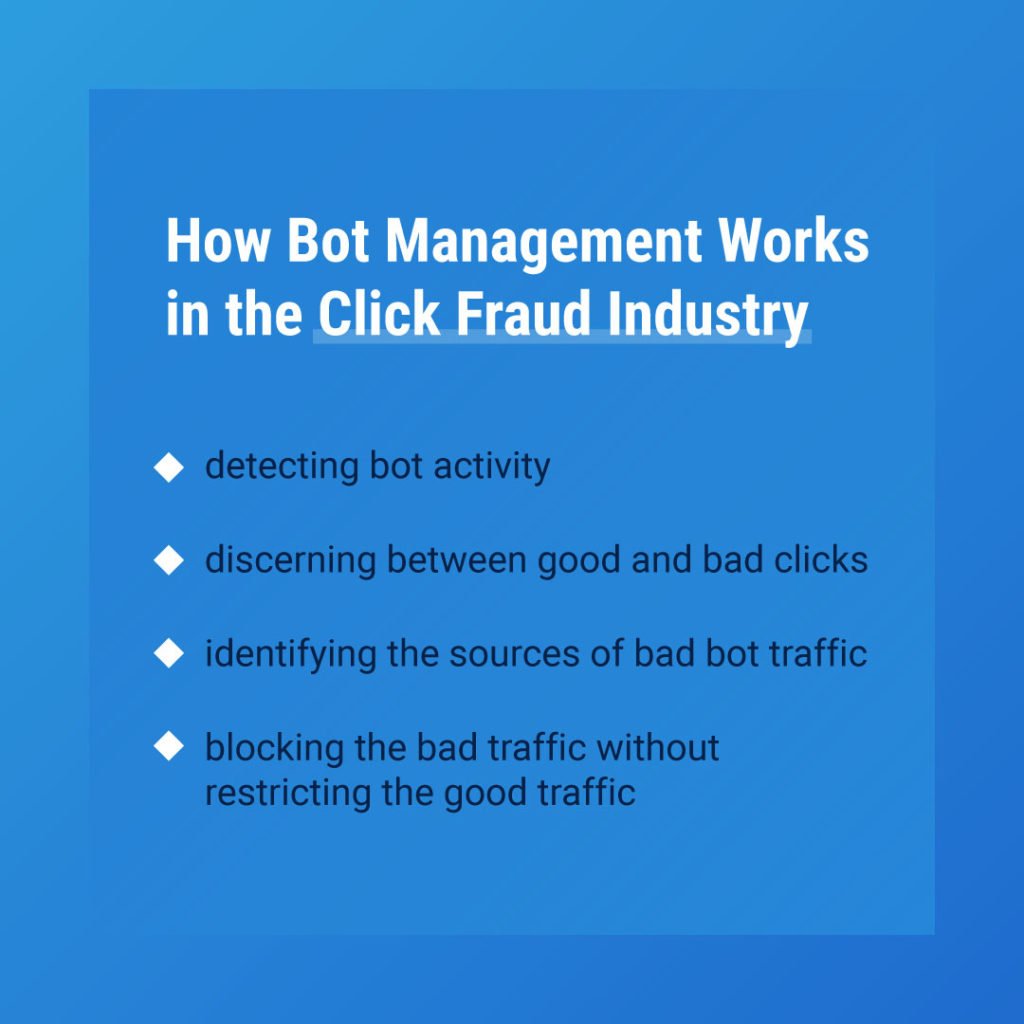
How does this work? Bot management for the click fraud industry usually consists of four elements:
- detecting bot activity
- discerning between good and bad clicks
- identifying the sources of bad bot traffic
- blocking the bad traffic without restricting the good traffic
Why Should You Care About Bot Management?
According to Statista, bot traffic accounts for almost 40% of all internet traffic. It is estimated that 15% of traffic is generated by good bot traffic, while about 25% is bad bot traffic.
Why does this matter? The fact that a quarter of internet traffic has malicious intent is a cause for concern. Bot management is important because “bad bots” can affect your website and your business in at least two main ways:
- They can overload servers, stopping or slowing down legitimate visitors that want to visit your site. This in turn can affect your conversion rates and your overall revenue.
- Bad bots can be used to steal your assets, like credentials or files – needless to say, you don’t want any sensitive information falling into the hands of wrong-doers.
None of these things is something you or your business are looking forward to.
Successfully using bot management software can help you prevent all of these bad things from happening.
Why Do You Need a Bot Management Software?
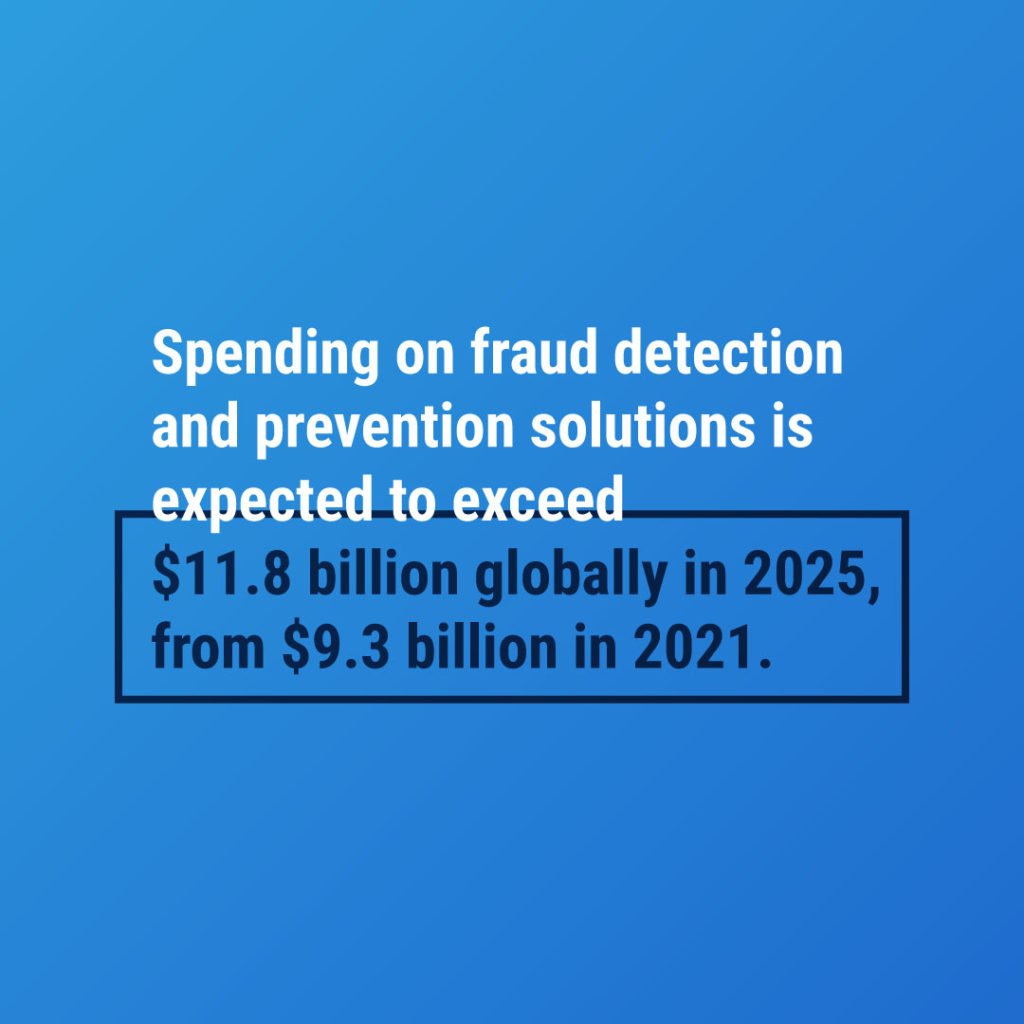
According to Juniper Research, retail losses to online payment fraud will exceed $206 billion cumulatively for the period between 2021 and 2025. The same research has also shown that spending on fraud detection and prevention solutions is expected to exceed $11.8 billion globally in 2025, from $9.3 billion in 2021.
Internet fraud is a real problem – and a growing one, for digital marketers, SEOs, and business owners alike.
The internet has come a long way and it is safe to assume most (if not all) internet fraud is powered by bots – pieces of code designed to automatically perform pre-defined actions.
Judging by the large number of bad bots out there, we can assume this is a lucrative business.
So how can you keep your business and your web assets safe?
The best way is prevention and being prepared to mitigate bot traffic.
This is where bot management solutions come in. Bot management software simplifies the process of identifying and stopping bad bot traffic.
Why Shouldn’t I Just Block All Bot Traffic?
OK, bots may cause some problems, but why should you manage bots? Can’t you just block all of them?
That would be a terrible idea. The internet is driven by bots and humans alike. As we’ve already pointed out, some have good intentions and some of them have bad intentions. And the good ones are actually useful.
For example, if you were to block search engine bots, your website would most likely lose traffic – as the “good” google bots wouldn’t be able to crawl it, it wouldn’t be indexed properly and it wouldn’t appear in relevant search results. This would affect your traffic, your conversions, and eventually your sales and your revenue.
How Does Bot Management Software Work?
Bot management raises two big challenges. On the one hand, you need to be able to identify bots that have become increasingly sophisticated at mimicking human behavior. On the other hand, you need to be able to distinguish malicious bots from legitimate bots.
A bot management software is supposed to support you in overcoming these challenges.
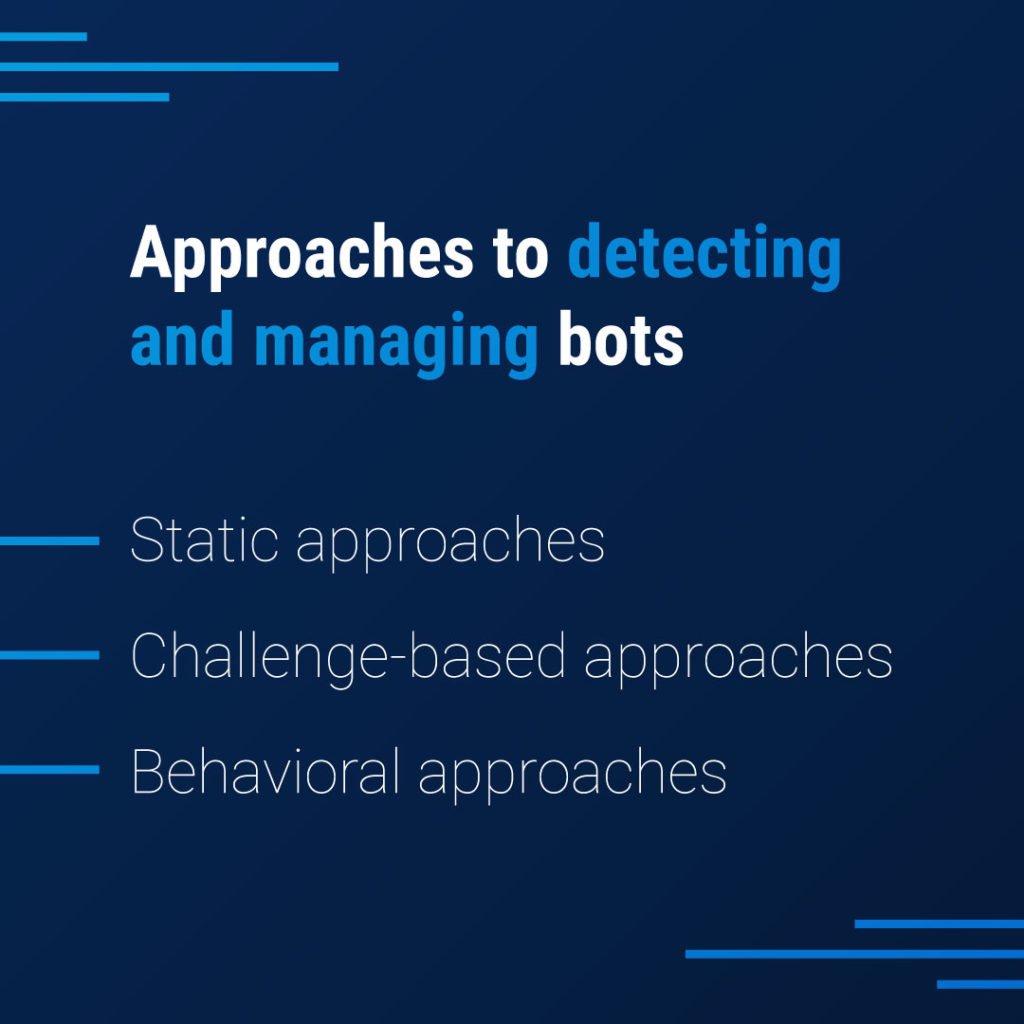
When it comes to detecting and managing bots, there are three main approaches:
- A static approach, which uses “static” analysis to identify information like header data, correlated with bad bot activity.
- A challenge-based approach, which uses challenges and tests (like CAPTCHAs) to differentiate and stop bot traffic.
- A behavioral approach, which evaluates activity and then matches it with known bot behavioral patterns.
In reality, however, the best approach is one that combines all of these three techniques. This will make bot management more efficient.
Good Bots, Bad Bots, Click Bots – What’s The Difference?
All right, we’ve talked about why bot management software is important and how to use it. But in order to use it efficiently, we need to understand the bot environment – what are we actually dealing with?
A bot is a software program or application designed to automatically carry out certain tasks.
Bots run according to their instructions, without human intervention (apart from their creation). That means that bots themselves are neither good nor bad. They can be used for “good” or “bad”.
The Good Bots
Good bots are designed and used to perform useful tasks. They are meant to help businesses and to make the internet a better (or more efficient place).
Here are some examples:
- Search engine bots: Also known as web crawlers, these good bots “crawl” or review content on the internet. The content is reviewed automatically by the bots and indexed so that it can show up in search results.
- Site monitoring bots: These bots are used to monitor various website metrics – for example, website status (including outages), backlinks, or keyword monitoring.
- Feed bots: These good bots crawl the internet looking for content that matches certain criteria. It is usually content considered “newsworthy” and that can then be posted on a news feed. These bots are also used by social media networks.
- Chatbots: As the name suggests, chatbots have been designed to “chat” – imitating human conversation by using pre-programmed responses.
The Bad Bots
If good bots are designed to handle useful tasks that bad ones are used for… wrong-doing.
Actually, bad bots are used by cybercriminals to do tasks that are in their best interest, but in turn, hurt other users or businesses.
Here are a few examples of bad bots:
- Content scrapers: These bots are designed to steal web copy, like product descriptions or articles. The content is then used on another site illegitimately, without pointing to the source.
- Carding and card cracking bots: As the name suggests, these are bots that perform financial fraud. They are used to verify stolen credit card numbers by making multiple small payments (carding) or by trying to identify missing information like expiry dates and CVV numbers (card cracking).
- Spam Bots: These bad bots are also known as fake news spam and comment spam, because they are used to spread fake news and even fake reviews. They can also be used to hide malware inside click-bait links.
- Click Bots: A click bot is a bot designed to execute click fraud, by accessing a webpage and clicking on links. Click bots have the ability to produce many clicks in a low amount of time.
Click Bots, Explained
When it comes to bad bots, click bots are a very interesting breed. And a worrying one, as they can rapidly deplete ad budgets and seriously affect a business’ PPC efforts.
At ClickGUARD, we talk a lot about click fraud and about how it happens.
Click bots lie at the foundation of click fraud. While it is still possible to manually click competitors’ ads to deplete their budgets but in the greater scheme of things, that isn’t a very efficient approach. It takes time, manpower, and costs. At the same time, there is a limit to how much a person can click.
Click bots, on the other hand, provide a more efficient way of deploying click fraud. Click bots can generate great a high amount of clicks in a very low amount of time. That makes them ideal for attacking and deploying a company’s ad budget.
Cybercriminals can use click bots to wreak havoc for any business – of course, they do this for the right price. We still don’t know all the ins and outs behind click fraud, but what we know is that making it more difficult for fraudsters to attack you is the best measure you can take against click bots.
At one point you can make it too expensive for cybercriminals to target you – that is why we recommend mitigating bots as part of your digital strategy.
ClickGUARD’s solution was designed with this functionality in mind: helping users identify and block malicious traffic. This is possible thanks to in-depth click forensics, which allow our users to identify potential click bots and control the traffic that comes in from their Google ads.
How to Choose Your Bot Management Software
When it comes to bot management software in general, a good bot management software usually has some common features:
- A bot management software should be reliable so that you can trust it with your IP addresses.
- Bot management solutions should be fast enough to forward all genuine traffic to your web servers.
- The software bot management system should work seamlessly, without causing any disruptions to your service or to normal web activities.
- A reliable bot management software should be restrictive enough to block bot traffic, but not too restrictive – for example, you don’t want it blocking genuine customer e-mails.
How should you approach bot management? Choosing one bot management software may be the best approach for some businesses. It may be enough to tackle existing bot detection and management needs.
For others, combining various tools might be a better option. For example, you may decide to use a generic bot management software together with a strong analytics tool and a software solution that stops click bots from ramaging your PPC campaigns.
The more complex your activity is, the more options you have. This is essentially a good thing – using several tools can offer you more data to help you make the best decisions.
FAQs
What is bot management?
Bot management can be defined as the process of identifying bot traffic, differentiating between legitimate bot traffic and malicious one, and then effectively blocking bad bot traffic while allowing the good traffic to reach your web property.
What is a bot manager?
A bot manager is a piece of software that manages bots. A bot management software will allow users to block bots that are considered malicious.
Why is bot management necessary?
Bad bot traffic can overload servers and stop web pages from being viewed by legitimate users. The consequences of this are enormous: without real web visitors, a business cannot efficiently promote its products or make online sales. Additionally, a site that is hard to reach can make a bad impression on potential customers.