
Let’s set the scene: you’re an e-commerce business owner or marketer working with Google Shopping Ads. Customers are flocking to your site. Conversion rates look great. But revenue growth just isn’t what you want. What gives (and what does the AOV meaning have to do with it)
If this sounds like you, it’s time to take a look at your AOV and understand its meaning.
What does AOV stand for, you ask? (Glad you did 😉)
What Does AOV Stand for in Google Shopping Ads?
It’s relatively simple – AOV, an acronym for Average Order Value, measures the average dollar amount spent each time a customer places an order. It is a useful e-Commerce metric you can use to monitor your business and increase revenue.
To calculate AOV, all you do is divide your total revenue by number of orders. AOV measures sales per order rather than sales per customer, so if you had $3,000 in sales after a total of 100 orders, your AOV would equal $30.
Now that you know what AOV stands for and how to calculate it, what will knowing your AOV do for you and your online business?
Why Is the AOV Meaning Important?
Before we get into strategies to improve your AOV in the next section, it’s important to get to the core of why AOV meaning is something online business owners should be taking a hard look at. Think of it this way: rather than spending time, effort, and money on increasing traffic, why not focus on increasing the amount spent by the customers you already have?
There are a myriad of ways to increase the average amount spent by customers at checkout – we’ll cover the best tips next – but understanding and optimizing AOV does more than give your online business a little revenue boost. It’s a long-term game that can change the way you operate your business.
The AOV meaning is important because it offers critical insight into your business, how it’s performing, and what it needs to do to perform better. With this benchmark as a jumping-off point, you can evaluate your pricing strategy and set goals to boost revenue.
Average order value meaning is important for marketers, e-Commerce store owners, dropshippers, and anyone else working with Google shopping ads to understand. Knowing what AOV stands for is just the start of building a better business that connects more deeply with your customers while turning a healthy profit.
If you know what shoppers are spending, you can learn from that behavior to implement new strategies and increase your profitability.
So, what are some techniques to do just that?
5 Essential Tips to Improve Your AOV in Google Shopping Ads
Let’s get beyond what AOV stands for and dive deeper into some strategies that can improve your AOV in Google Shopping Ads. These five essential tips are for anyone working with shopping ads including marketers, e-Commerce store owners, and dropshipping business owners.
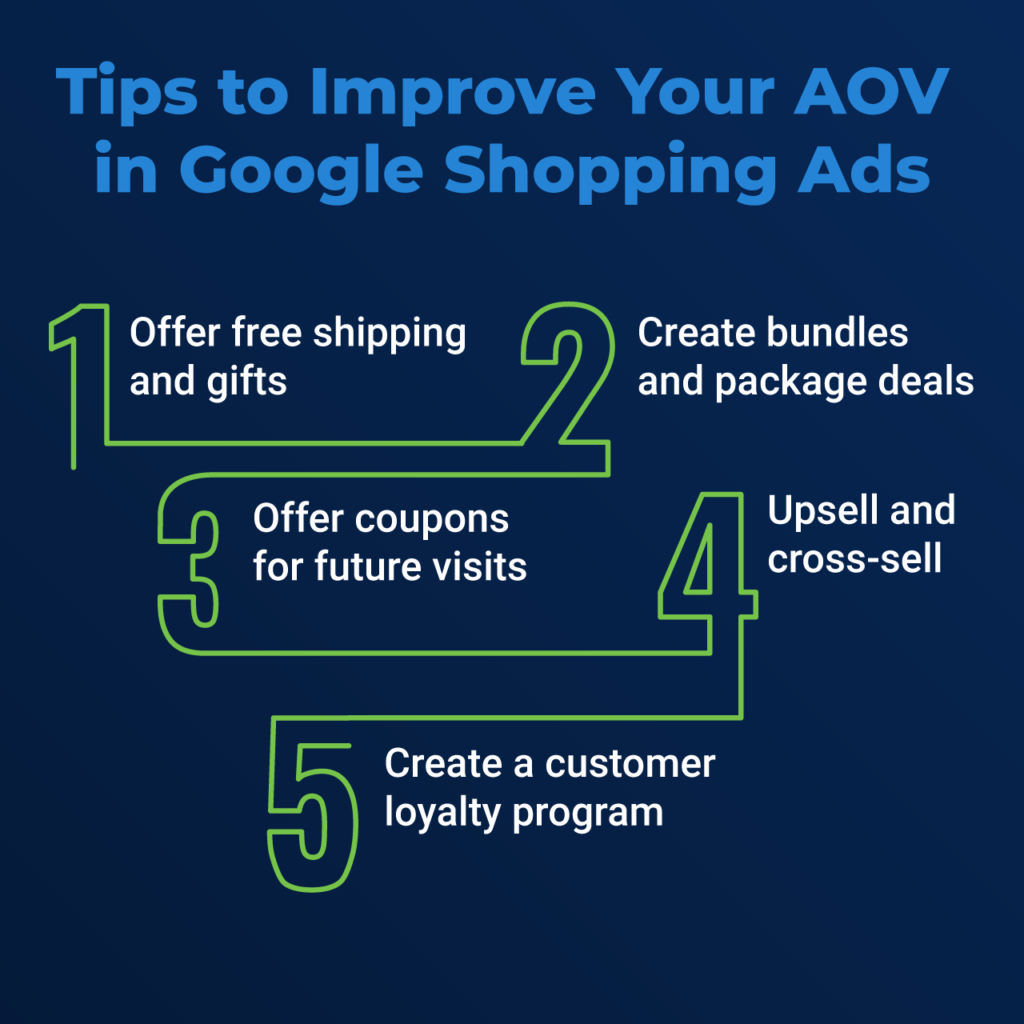
Offer free shipping and other gifts on minimum order values
If you aren’t offering free shipping through your e-Commerce store, prepare yourself for some insane statistics that might make you rethink your strategy.
86 percent of customers who abandon their cart when checking out online do so because of the cost of shipping. Think about that – by offering free shipping, you could retain up to 86 percent of people who would have left your site without purchasing what was in their cart already.
On top of that stat, 93 percent of customers would add more items to their cart just to qualify for free shipping.
Creating a minimum order value for free shipping can clearly boost your sales. It can be tough to find a financially feasible way to do so, though, so you’ll have to get savvy.
To cover the cost of free shipping while still increasing revenue, set a minimum order value that is about 30% higher than your AOV. Just make sure the cost is still attainable to the customers you sell to; else you risk customers abandoning their carts.
Outside of free shipping, consider other tactics like offering discounts on minimum order values. You could offer a $5 or $10 discount at checkout when a customer spends $50 or more.
Create bundles and package deals
Bundles and package deals are a simple yet effective way to drive up your AOV, and the sky’s the limit when it comes bundling products and offering package deals.
Offer a 30% discount when a customer buys 3 or more of the same product.
Offer free shipping to customers when they buy a “kit” or package of items rather than a single item.
Let customers have fun with it and create their own bundles for a discount.
You can also create a “sample package” that gives your customers the option to try products in trial or sample sizes, rather than purchase them full size.
Each of these options offer customers an incentive to purchase more than what they would have, increasing their satisfaction and your AOV. Win-win!
Who knew that understanding what AOV stands for could lead to all these exciting new initiatives and offers for your business?
Offer Coupons for Future Visits
Now that you know the AOV meaning, you can get even more strategic about customer offers. Everyone loves coupons, so what better way to improve your AOV than to bring customers back with a discount promise?
Digital coupons can help boost AOV by 1) getting your customers excited to visit your site again, and 2) incentivizing them to purchase above a certain threshold. For example, you can offer customers $5 off their next purchase of $50. This encourages customers to spend at least $50 (or a number of your choosing).
If you’re not sold on coupons (pun intended), check out these stats from SocialMediopolis:
– 48% of customers purchase something sooner when they have a coupon.
– 38% purchase a more expensive product
– 41% seek out something to purchase
The case for coupons is strong! They are proven to bring customers to your store more quickly and buy more than usual, which will have a strong impact on your AOV.
As an e-Commerce store owner, offering digital coupons to your customers is the way to go.
Upsell and Cross-sell
These tactics are tried-and-true. Imagine buying a medium drink at a drive-through, and being asked, “Would you like to upgrade to a large for just $1 more?” Most of us lean toward a ‘yes’ because the offer is just… better. That’s an upsell. Just make sure your upsell is not too pushy – think of more like a recommendation.
Cross-selling offers a different but complementary product to the one the customer is already purchasing. A lot of e-Commerce sites do this with suggestions like “customers also bought” or “this product pairs well with” when a customer is browsing.
By using these methods you can improve your AOV while also increasing customer satisfaction and making your brand stand out.
Now that you know what AOV stands for, you can monitor how well your business performs after implementing techniques like upselling and cross-selling.
Set Up a Customer Loyalty Program
The final essential tip to improve your AOV in Google shopping ads is to set up a customer loyalty program. Offering rewards for returning to your business site is a retention strategy that will impact your AOV and build trust with your customers. Loyalty programs are well-known to be imperatives for savvy business owners, resulting in increased revenue, savings, satisfied customers, and new traffic.
Innovative loyalty programs focus on increasing value for the customer and giving them a reason to stay loyal to your brand. If you’re a small retailer you can come up with programs that are financially feasible for your business, such as a tiered loyalty program that offers more exclusive rewards the more a customer spends.
With a loyalty program that offers rewards and recognition, your customers don’t feel like just another sale. Loyalty programs make people feel special. Customers appreciate the appreciation and will feel more connected to your brand.
Knowing AOV’s meaning (and how to improve it) is absolutely essential when running Google shopping ads.
While improving AOV, you can forge strong relationships with your customers by increasing trust and loyalty, encourage repeat customers by offering discounts on future visits, decrease cart abandonment and make customers happy with free shipping, and making shopping a little more enjoyable with bundles and packages.
Remember – understanding AOV meaning and implementing smart strategies to improve it will increase your revenue while also giving you a future-centered mindset that can change the way you run your business. Taking AOV into account will keep you and your business growing, strategizing, learning, and improving.